What Are Container Chassis? Uses, Users, and Locking Mechanism Explained
Discover container chassis, their applications in ports and logistics, how containers are mounted, and how twist lock mechanisms work.
Introduction
In global logistics and freight transportation, container chassis play a critical yet often overlooked role. Without them, intermodal container movement by road would be nearly impossible. Container chassis form the backbone of efficient container transport between ports, rail yards, warehouses, and distribution centers.
This blog explains:
What container chassis are?
Where they are used?
Who uses them?
How containers are fitted onto chassis?
What locking mechanism secures the container?
What Are Container Chassis?
A container chassis is a specialized wheeled trailer frame designed specifically to transport ISO shipping containers over roads. Unlike flatbed trailers, a container chassis is built to support the container only at its four corner castings, not across the entire base.
Key features include:
Steel frame construction
Axles (single, tandem, or tri-axle)
Suspension system
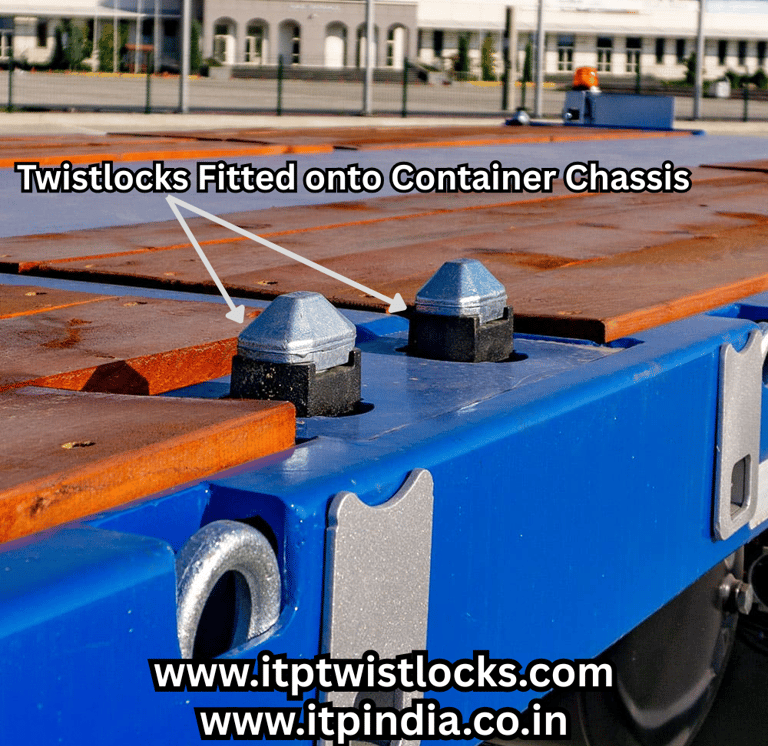
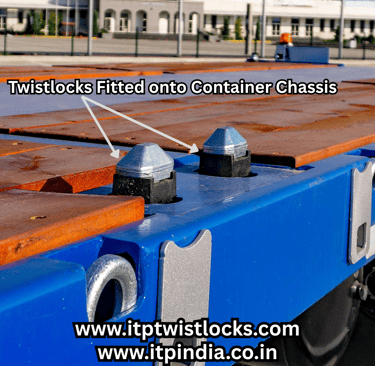
Twist lock mechanisms
Landing legs
Kingpin for tractor connection
The chassis itself does not have walls or a floor it relies on the container for cargo enclosure.
Where Are Container Chassis Used?
Container chassis are widely used in intermodal logistics, including:
Seaports – transporting containers between ship terminals and inland locations
Rail yards – moving containers between rail wagons and trucks
Logistics hubs & ICDs (Inland Container Depots)
Warehouses & distribution centers
Cross-border freight operations
They enable seamless movement of containers across sea, rail, and road networks.
Who Uses Container Chassis?
Container chassis are used by a wide range of stakeholders in the logistics ecosystem:
Port operators
Shipping lines
Freight forwarders
Logistics & transport companies
Intermodal operators
Container leasing companies
Fleet owners & trucking companies
In some regions, chassis are owned by shipping lines, while in others they are owned or leased by independent chassis pools.
How Are Containers Fitted Onto a Container Chassis?
Containers are fitted onto chassis using top lift or side lift handling equipment, such as:
Reach stackers
Container cranes
Forklifts (for empty containers)
Fitting Process:
The chassis is positioned on a level surface
The container is lifted from above
The container is carefully lowered so that its corner castings align with the chassis twist locks
Once seated, the locking mechanism is engaged
The entire container load is transferred through the four corner castings, which are engineered to carry the full container weight.
What Mechanism Is Used to Lock the Container?
Twist Lock Mechanism (Corner Lock System)
The twist lock is the standard mechanism used worldwide to secure containers to a chassis.
How Twist Locks Work:
Each twist lock inserts vertically into the container’s corner casting
The lock is rotated 90 degrees (manually or automatically)
Once rotated, the lock prevents vertical or lateral movement
This ensures the container remains firmly secured during transit
Types of Twist Locks:
Manual twist locks – rotated by hand using a lever
Semi-automatic twist locks – lock automatically when the container is placed
Fully automatic twist locks – require no manual intervention
Most container chassis use four twist locks, one at each corner.
Why Twist Locks Are Critical for Safety?
Properly functioning twist locks:
Prevent container shifting or detachment
Ensure road safety
Protect cargo integrity
Comply with international transport regulations
Regular inspection and maintenance of twist locks are essential for safe operations.
Common Container Chassis Configurations
20 ft chassis
40 ft chassis
Extendable (slider) chassis for 20–40 ft containers
Tri-axle chassis for heavy or regional compliance
Gooseneck chassis for high-cube containers
Each configuration is designed to meet specific load and regulatory requirements.
Conclusion
Container chassis are a vital component of modern logistics and intermodal transport. They allow standardized containers to move efficiently and safely across road networks using a simple yet robust twist lock corner locking system.
Understanding how container chassis work—and how containers are secured—helps fleet owners, logistics operators, and manufacturers ensure safe, compliant, and cost-effective container transport worldwide.
INTERNATIONAL TRAILER & PARTS
MANUFACTURER, EXPORTER & SPECIALIST IN CAST, FORGE & SHEET FABRICATION, WELDED & MACHINED PRECISION PARTS
Email:-
0091-7888609669
Copyright 2025 © INTERNATIONAL TRAILER & PARTS, All Right Reserved
itpror@yahoo.com
phone:-
websites:-
www.itptwistlocks.com
Privacy & Policy
Terms & Service